Bench note · 19 November 2026
Air-dry clay: why the cracking curve is a formulation issue
Air-dry clay hardens by losing water, and every formula loses water unevenly. The cracks that appear on a child's project are decided by the binder, the filler and the thickness of the piece.
What air-dry clay is
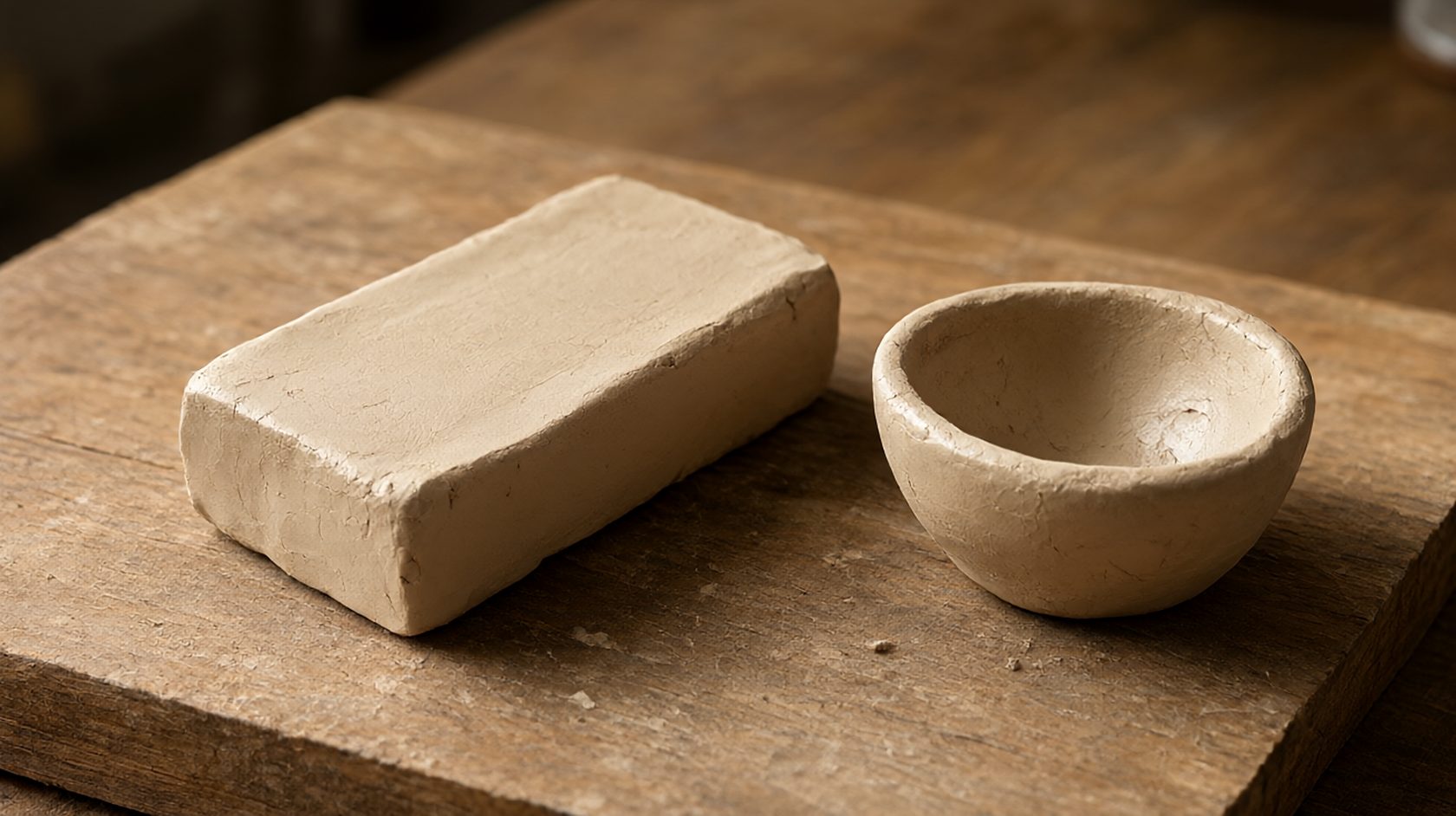
Air-dry clay is a water-based paste of mineral filler, a polymeric binder, a plasticiser and a preservative. It dries in air rather than in a kiln, which is its commercial advantage and its technical weakness.
The filler is usually calcium carbonate or a clay mineral; the binder is a polyvinyl acetate or an acrylic dispersion; the plasticiser keeps the paste workable in the bag.
The drying process is water leaving through the surface. The outside dries first and shrinks; the inside is still wet and does not. That differential is the crack.
Everything a factory does to make the clay pleasant to handle - more water, more plasticiser, softer binder - makes the differential worse, which is why the best-feeling clay is often the worst-drying one.
Thickness, shrinkage and the geometry of a crack
A piece thinner than five millimetres rarely cracks, because the moisture gradient across its thickness is small. A piece thicker than fifteen millimetres almost always cracks somewhere.
The geometry matters as much as the thickness: a thick piece with a thin appendage dries at two rates, and the crack runs at the junction where the rates meet.
Shrinkage is typically three to eight per cent by length for a water-based clay. A piece that is constrained - pressed onto a board, wrapped around a form - cannot shrink freely and cracks at the constraint.
The practical advice to a maker is to build hollow, to dry slowly, and to avoid joining thick to thin. The practical advice to a factory is to state the maximum recommended thickness on the pack.
The binder that holds it together, and the one that does not
Polyvinyl acetate is cheap, flexible and water-sensitive. A clay bound with it re-softens if the finished piece gets damp, which is a problem for a product used by children.
Acrylic binders are more water-resistant and more expensive. A blend is common, and the blend ratio decides whether a dried piece survives a humid summer.
The binder also decides the surface. A high-binder clay dries to a smooth, slightly glossy skin that accepts paint; a low-binder clay dries chalky and drinks paint.
The specification should name the binder system and the dried film's water resistance, tested by wetting a cured sample for ten minutes and rubbing it.
Preservatives and the bag that smells
A water-based paste with organic binder is a food source for micro-organisms. A clay without adequate preservation develops a sour smell, mould on the surface, and eventually a colour change.
The preservative has to be compatible with the binder and with the pH of the paste. A preservative that is effective in a neutral paste can be inactive in an alkaline one.
The manufacturing risk is the batch that is made, held warm, and filled the next day. Preservation assumes a clean process; a tank that is not cleaned between batches defeats it.
The buyer's test is a sealed bag held at 30 degrees for four weeks, opened and smelled. It is an unpleasant test and it is the one that predicts what a customer will experience.
Colour, staining and the table it ruins
Pigmented clay transfers colour to hands and to surfaces while it is wet. The transfer is proportional to the pigment loading and to the amount of free water.
A clay that is pleasant to work with is usually a clay that marks a table. The product's marketing has to accept that, or the formula has to reduce the free water and accept a stiffer feel.
Staining tests should include a wet piece left on a lacquered surface for an hour, and a wet piece rubbed on fabric. Both are cheap and both predict the complaint volume.
The packaging should carry a note about covering the work surface, which is a design decision that costs nothing and prevents a category of complaint that is otherwise unavoidable.
The kit, the tools and the shelf life
An air-dry clay kit is a clay plus tools plus a project guide, and each of the three can fail independently. A good clay with a brittle tool set is a kit with a returns problem.
Tools are usually polystyrene or polypropylene. Polystyrene cracks at the thin end; polypropylene bends and is the better choice for a tool that a child will lever with.
Shelf life is set by the bag's barrier and the preservative. A clay in a metallised bag holds twelve months; the same clay in a polyethylene bag holds four.
The date code belongs on the bag, not only on the carton. A bag that is separated from its carton in a warehouse is a bag whose age nobody knows.
Drying rooms and the school timetable
A classroom dries pieces on a windowsill, which means a draft on one side and a warm radiator on the other. The clay's drying curve assumes neither.
A clay that dries slowly is a clay that fits a classroom, because the piece is still workable at the end of the lesson and dries overnight without cracking.
A clay that dries quickly is a clay that suits a factory's production line and a hobbyist's impatient afternoon, and it is the harder product to formulate.
The pack should say how long a piece takes to dry at a stated thickness. A child who expects overnight and gets three days is a child who pokes the piece and breaks it.
The instructions as a specification
The instruction leaflet is the only document most buyers will ever read, and it should carry the numbers the formula depends on.
Thickness, drying time, joining method and the warning about covering the surface: four items that decide whether the product's promise is met.
A leaflet that says 'shape it and leave it' is a leaflet that produces cracked pieces and a review about the clay, when the problem was the instruction.
The leaflet should be tested on five people who have never used the product. If two of them produce a cracked piece, the leaflet is wrong, not the clay.
The piece that is too dry to join
Air-dry clay joins with slip, and slip needs both surfaces to be damp. A piece that has dried for an hour cannot be joined reliably, and the join will crack later.
The pack should say to join while damp and to score the surfaces. Two sentences that prevent most of the cracked joins a family will experience.
The classroom that has one sink
A classroom with one sink and thirty children is a classroom where clay dries between uses. A clay that rehydrates easily is a better classroom product than one that is merely pleasant.
Rehydration is a formulation property: a clay with a higher water content and a softer binder comes back with a splash of water, and a stiff one does not.
Whiteness, and the parent who compares brands
White air-dry clay is judged on whiteness, and whiteness is a function of the filler. A calcium carbonate filler that is slightly off-white reads as grey against a competitor's bright white.
The comparison happens on a shelf, not in a test report. The standard should be a shelf comparison under retail lighting.
The tools and the mat in the box
A kit that includes a mat and tools sells better and returns more. The mat stains, the tools snap, and both are visible in the first week.
The mat should be silicone or coated paper, and the tools should be polypropylene. Neither is expensive, and both remove a predictable complaint.
The drying time claim on the pack
A pack that claims 'dries in 24 hours' should mean at the stated thickness in a normal room. A thick piece will take three days, and the customer will blame the product.
The claim should carry its condition, as a weight rating carries a door width. A conditional claim is a claim that holds.
A clay that dries without cracking at the thickness on the pack is the ultra-light air-dry clay, and its binder system is what decides whether a dried piece survives a humid summer.
What to check
- Binder system and dried-film water resistance specified
- Maximum recommended thickness stated on the pack
- Sealed-bag preservation test at 30 C for four weeks
- Staining test on lacquer and fabric while wet
- Tool material chosen for the way children use it
- Date code on the bag as well as the carton