Bench note · 19 November 2026
Bath toys: drainage, mould and the design that prevents both
A rubber duck is a hollow body with a hole in it, sold into the wettest environment a toy will ever see. The mould inside is a design decision, not a cleaning failure.
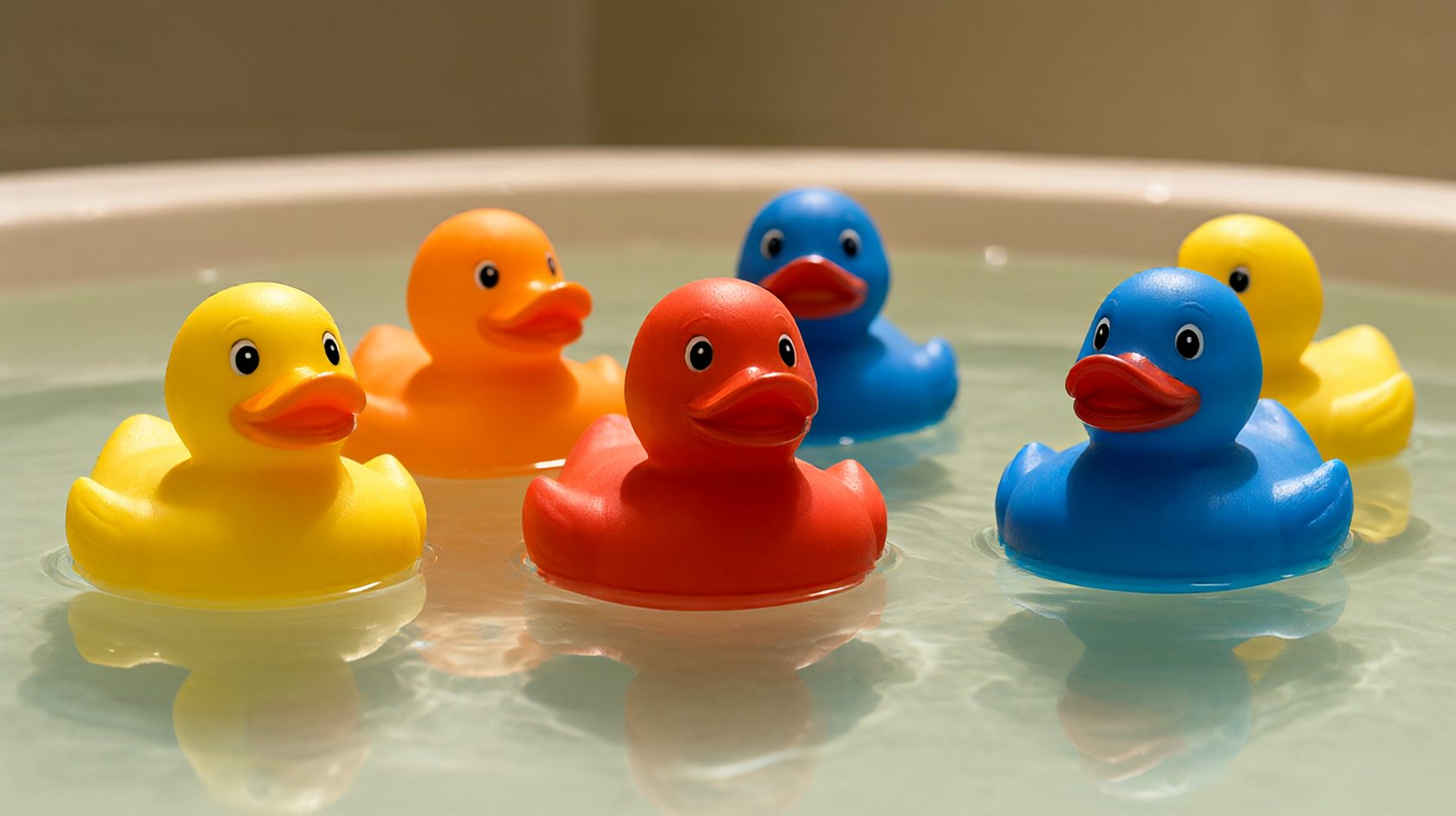
Why bath toys grow mould
A bath toy is a hollow moulding with an air hole, and every squeeze draws water into the body. The water that stays inside is warm, nutrient-rich from bath products, and dark.
Mould grows on the inner surface within weeks, and the visible evidence is black specks that come out when the toy is squeezed. By then the growth is established and cleaning cannot reach it.
The industry's usual answer is a hole that drains, and a hole that drains is only effective if the toy can be emptied completely. Most cannot, because the hole is small and the body has a re-entrant shape.
The design answer is a body that opens, or a body with two holes positioned so that water flows through under gravity and air replaces it.
Two holes, and where they go
A single hole traps water because air cannot enter as water leaves. A second hole, placed at the highest point in use, lets air in and lets water out.
The holes should be at opposite ends of the body's long axis, and the lower one should be at the lowest point when the toy floats upright. A hole at the top of a duck's head drains nothing.
A two-hole design also lets a parent rinse the body, which is the practical difference between a toy that can be maintained and one that has to be replaced.
The holes need a rim that does not tear during repeated squeezing. A thin wall around a small hole develops a crack at the rim within a season.
Materials and the biofilm that forms on them
Natural rubber and soft PVC are pleasant to squeeze and friendly to biofilm. Their surfaces are slightly porous and their plasticisers feed micro-organisms.
Silicone and TPR are smoother and less hospitable, and a well-cured silicone surface resists biofilm better than a plasticised PVC one.
The material choice is therefore a hygiene decision as well as a tactile one, and it should be made with the cleaning regime in mind: a toy that is designed to be rinsed weekly should not be made from the material that holds water.
Material hardness matters too. A softer shell flexes more, and more flexing means more water drawn in per squeeze.
The cleaning claim, and what it is worth
A claim that a bath toy is 'mould resistant' is a claim that has to be supported. The support is a test: inoculate the inner surface, hold it in bath-like conditions, and inspect.
A claim that a toy is 'dishwasher safe' is a different claim, and it depends on the material's temperature tolerance rather than on its hygiene. A toy that survives the dishwasher can still grow mould between washes.
The honest label says how to drain and how often to rinse, and it does not promise sterility. A parent who knows to drain a toy is a parent who will not find black specks.
The dishonest label promises an outcome the design cannot deliver, and the reviews that follow are predictable.
Sealing the hole without sealing the water in
Some designs use a plug or a cap. A cap keeps water out and keeps the interior dark, which is the perfect environment for the mould that was already there.
A cap also creates a small-part risk if it can be removed by a child, and a choking hazard assessment has to cover it.
The better approach is a design that does not need a cap: two holes, a body that drains, and a shape that can be squeezed dry in a few seconds.
Where a cap is unavoidable, it should be tethered and it should be vented, so that the interior can dry even when the cap is in place.
Testing the design before the tool is cut
A bath toy's hygiene performance can be tested with a prototype and a bucket. Fill, squeeze, drain, and measure how much water remains after thirty seconds.
A design that retains more than a few millilitres is a design that will grow mould. The measurement is crude and it is more useful than any specification.
The second test is a squeeze cycle: a thousand squeezes, then inspect the hole rims for cracking and the body for stress marks.
Both tests cost a day and can be run on a 3D-printed or hand-modelled prototype, which is far cheaper than discovering the problem after the mould is made.
PVC or silicone in a wet room
Plasticised PVC is soft, cheap and pleasant, and it is the material most associated with bath toys. It is also the material that plasticiser migrates out of when it is warm and wet.
Silicone is more expensive, more stable and easier to clean. A silicone duck costs more per unit and generates fewer complaints about smell and surface tack.
TPR sits between the two: softer than silicone, cleaner than PVC, and cheaper than both at scale.
The material choice should follow the cleaning regime. A toy that will be rinsed and drained weekly is a toy that can tolerate PVC; a toy that will sit wet in a bath caddy is not.
The second-life question
Bath toys are small, cheap and often discarded rather than passed on, and the material choice decides whether they can be recycled at all.
A single-material silicone toy can be recycled in a silicone stream; a PVC toy with a printed surface and a foam insert cannot be separated economically.
The design decision that helps is a single material and a moulded colour rather than a printed one. Two changes that make the product recyclable and cost very little.
Brands that publish a take-back or a material statement are answered with a better review than brands that do not. The question is being asked by customers now.
The bath caddy that never dries
A toy that lives in a caddy stays wet between baths, and wet storage is the condition that defeats a drainage design.
The product should be designed to be stored dry: a shape that sits on a shelf without trapping water, and a note on the pack about drying it after use.
The squeaker and the hole it needs
A squeaker needs an air path, and the air path is the water path. A toy that squeaks is a toy that can be filled.
The choice is between a squeak and a closed body. A brand can have one; claiming both is what produces the mould.
The spray nozzle that cleans nothing
Some brands sell a cleaning spray. A spray that reaches the hole but not the inner surface is a spray that does not solve the problem.
The honest accessory is a drying rack or a two-hole design, not a bottle of liquid that promises to disinfect a surface it cannot reach.
Small parts and the age grading
A bath toy for a six-month-old and one for a three-year-old are different products. The eyes, the beak and any accessory must pass the small parts test for the younger group.
Moulded eyes are safer than inserted ones, and they cost more. The difference is a tool change, not a component change.
The colour that fades in chlorinated water
Bath water contains chlorine and the toys are stored wet. A pigment that is not chlorine-fast will fade within a season, and the fade is uneven because the toy is half submerged.
The pigment should be tested in chlorinated water at bath temperature for a hundred hours. The test is cheap and it predicts the shelf complaint.
The review that mentions black specks
A single review that mentions black specks can end a bath toy's season. The specks come out on a squeeze, and they come out for years.
The prevention is design, and the response to an early review is a design change rather than a cleaning instruction.
The design that drains without a cap is the one behind the rubber bath ducks, and its second hole is the detail that decides whether the body can be rinsed.
What to check
- Two drainage holes at the body's extremes, verified on a prototype
- Residual water measured after a 30-second drain
- 1000-squeeze cycle test on hole rims
- Material chosen for cleanability, not only for feel
- Cap, if used, tethered and vented
- Cleaning instructions that match what the design can do