Bench note · 19 November 2026
Polymer clay kits: colour consistency across a sixty-colour set
A sixty-colour polymer clay kit is a colour management problem disguised as a toy. The colours have to match across batches, survive baking, and stay distinguishable from each other.
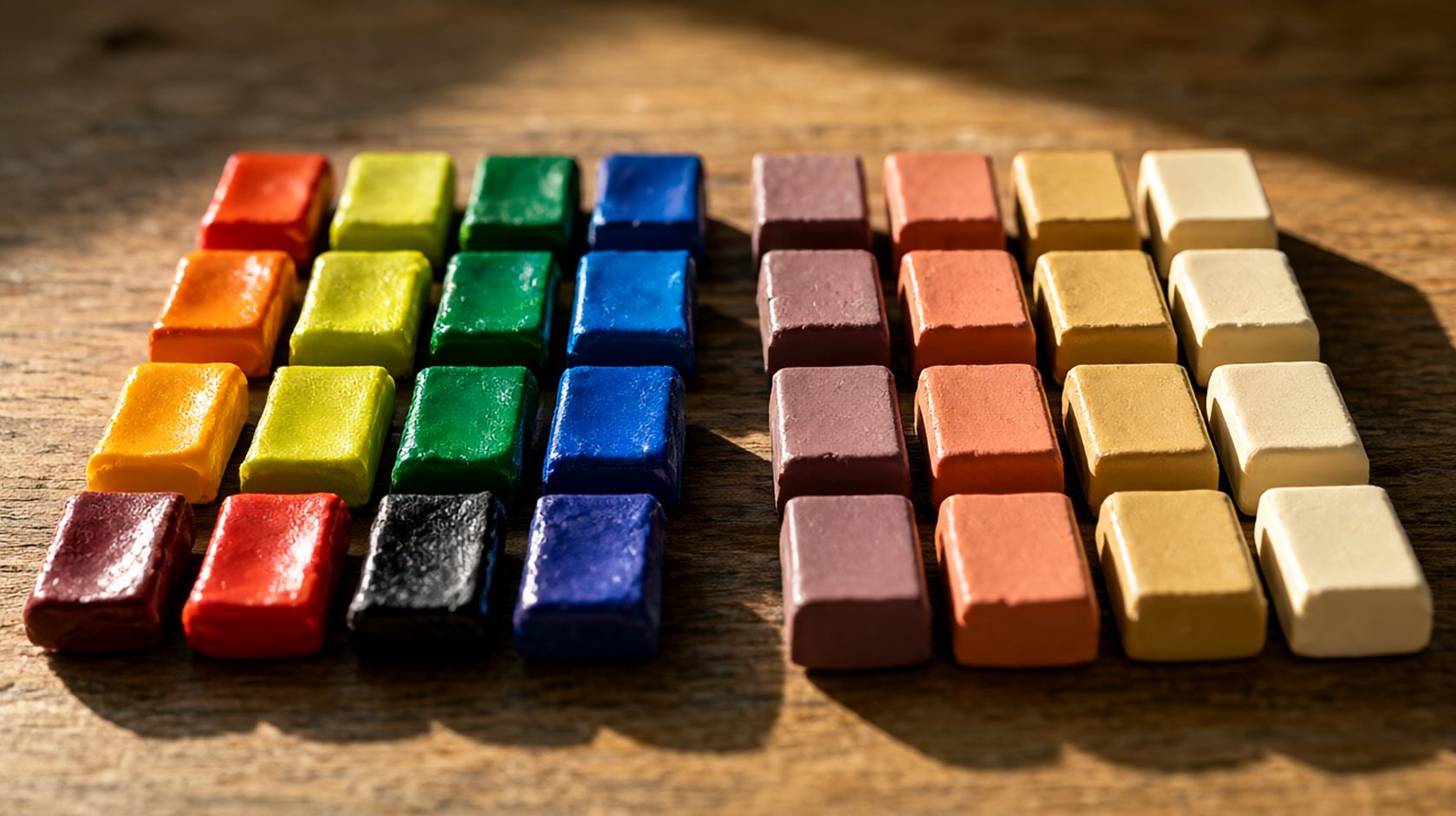
What polymer clay is, and why the colour is hard
Polymer clay is polyvinyl chloride dispersed in a plasticiser, with filler and pigment. It stays workable until it is baked, when the plasticiser migrates and the piece hardens.
The colour is pigment dispersed into the PVC paste. Dispersion quality decides whether a colour is uniform or speckled, and pigment loading decides whether the baked colour matches the raw colour.
Baking changes colour. Most pigments shift slightly at 110 to 130 degrees Celsius, and the shift depends on the pigment chemistry rather than on the brand.
A sixty-colour kit therefore has sixty colours that each shift a little differently, and the set only looks coherent if the shift has been measured rather than assumed.
Colour matching across a set
The eye compares adjacent colours, not absolute ones. A set looks coherent when the steps between neighbouring colours are even, and it looks wrong when two colours that should be distinct are nearly the same.
The practical method is to define the set in a colour space and then check the baked samples as a group, not one at a time. A group check finds the pair that collapses.
Pigment suppliers quote a colour for a standard let-down, and the factory's let-down differs. The only reliable match is a baked chip made from the factory's own paste.
The approved standard should be a set of baked chips stored away from light, with the batch records that produced them. Digital values are useful for communication and useless for approval.
Baking, shrinkage and the piece that warps
Polymer clay shrinks as the plasticiser migrates. The shrinkage is small - typically one to three per cent - and it is enough to change a joined piece's geometry.
A piece with mixed thickness bakes unevenly, and the uneven bake is what warps a flat shape. The oven's air flow matters as much as its temperature: a piece near the fan dries faster than one at the back.
The kit's instructions should name a temperature and a time for a piece of a given thickness, and they should name the thickness. Instructions that say 'bake until hard' are instructions that produce a burnt piece.
A factory that tests its own recommended schedule, in its own oven, with a thermocouple, knows what the customer will experience. A factory that quotes the resin supplier's schedule does not.
Plasticiser migration and the box that goes oily
Plasticiser migrates out of the clay and into anything it touches: the packaging film, the card insert, the other colours in the pack.
In a kit, the migration between colours is the visible problem. A light colour next to a dark one can pick up a haze, and the haze is irreversible.
The control is a barrier between the colours - a small bag per colour, or a card tray with a coated surface - and a storage test at 40 degrees with the colours in contact.
The test is simple and it is decisive: pack the kit as it will ship, hold it warm for four weeks, and open it. A kit that has survived that test will survive a container.
The tool set and the age grading
A polymer clay kit usually includes modelling tools, a mat and instructions. The tools are the part that breaks, and the mat is the part that stains.
Tools should be metal or a stiff nylon. A polystyrene tool snaps at the tip within a week of use, and a snapped tool is a complaint about quality rather than about the toy.
The mat should be a coated paper or a silicone sheet. A plain paper mat absorbs plasticiser and becomes translucent, which looks like a manufacturing defect.
The age grading has to be consistent across the whole kit: the clay, the tools and any small accessory. A kit graded six-plus with a three-plus tool is a kit that fails an audit.
Sampling plan for a large colour set
A sixty-colour kit cannot be inspected colour by colour on every shipment, and it should not be. The plan should sample the extremes and the mid-tones, plus any colour that has changed supplier.
The extremes - the lightest and the darkest - are where a shift is most visible. The mid-tones are where a set's coherence is decided.
The record should name which colours were checked, by number, and what they were compared against. 'Colour checked, OK' is not a record.
A supplier who resists a named sampling plan is a supplier who has been changing pigment without telling anyone. The plan is the conversation.
Oven calibration across a classroom
A home oven's thermostat is often ten to fifteen degrees away from its set point, and the error is not constant across the dial. A polymer clay schedule that assumes accuracy will burn pieces in some ovens and underbake them in others.
The instruction should give a temperature range and a test method: bake a small test piece first, and note how it behaves. A test piece costs nothing and prevents a ruined project.
A convection oven circulates air and bakes faster than a still oven at the same setting. The schedule should say which type it assumes, or give a range that covers both.
The factory's own oven is calibrated and the customer's is not. The gap between the two is the reason a product's instructions have to be conservative.
Conditioning before use
Polymer clay is stiff when cold and soft when warm. A block that has been in a cold warehouse is difficult to condition, and a buyer who opens it in winter will think the product is hard.
Conditioning is mechanical: kneading and rolling warms the clay and redistributes the plasticiser. The pack should say to work it in the hands for a minute before use.
A clay that needs two minutes of kneading is a clay with a high filler loading. A clay that softens in ten seconds is a clay with more plasticiser and a lower shape retention.
The two properties trade against each other, and the kit should be formulated for the way it will be used: a moulded piece needs shape retention, a sculpted figure needs softness.
The colour that looks different on a screen
A colour card rendered on a screen and printed on a box will differ from the clay. The box should be printed from a proof made with the clay, not from a digital file.
The proof is the standard for the packaging, and the baked chip is the standard for the product. Confusing the two produces a kit whose colours do not match its box.
Blocks, sticks and the format decision
A kit sold as blocks gives the buyer more material per colour and a heavier box. A kit sold as sticks gives more colours and less material.
The choice is commercial, and it is also practical: a stick is easier for a child to condition, and a block is easier to slice for a mould.
The tool that leaves marks
Polymer clay tools leave marks that survive baking. A tool with a sharp edge cuts a line that is still visible after the piece is cured.
The tool set should be chosen for the marks it makes, and the instruction should tell the buyer to smooth before baking rather than after.
Baking on what surface
A tile, a ceramic plate and baking paper behave differently. A tile holds heat and can overbake the underside; paper insulates and can underbake it.
The instruction should name a surface and a test piece. A buyer who bakes on the wrong surface will blame the clay.
Mixing colours and the set's coherence
A sixty-colour set invites mixing, and mixing is where the set's design matters: a palette with a clean yellow, a clean magenta and a clean cyan can mix anything.
A palette built from tints and shades of ten hues cannot. The set's colour selection is an educational decision disguised as a range.
The set whose colours stay distinguishable after baking is the 60-colour polymer clay kit, and its baked chips are the standard to compare against rather than its printed colour card.
What to check
- Baked chips approved as a set, not colour by colour
- Baking schedule tested in the factory's own oven with a thermocouple
- Migration test with colours in contact at 40 C for four weeks
- Tool material specified as metal or stiff nylon
- Age grading consistent across clay, tools and accessories
- Named colour sampling plan per shipment