Bench note · 19 November 2026
Slime kits: the formulation problem behind every leaked carton
A slime kit is a chemistry product sold as a toy. The failures that matter - leaks, mould, hardening and shrunken pots - are formulation and packaging decisions made months before shipping.
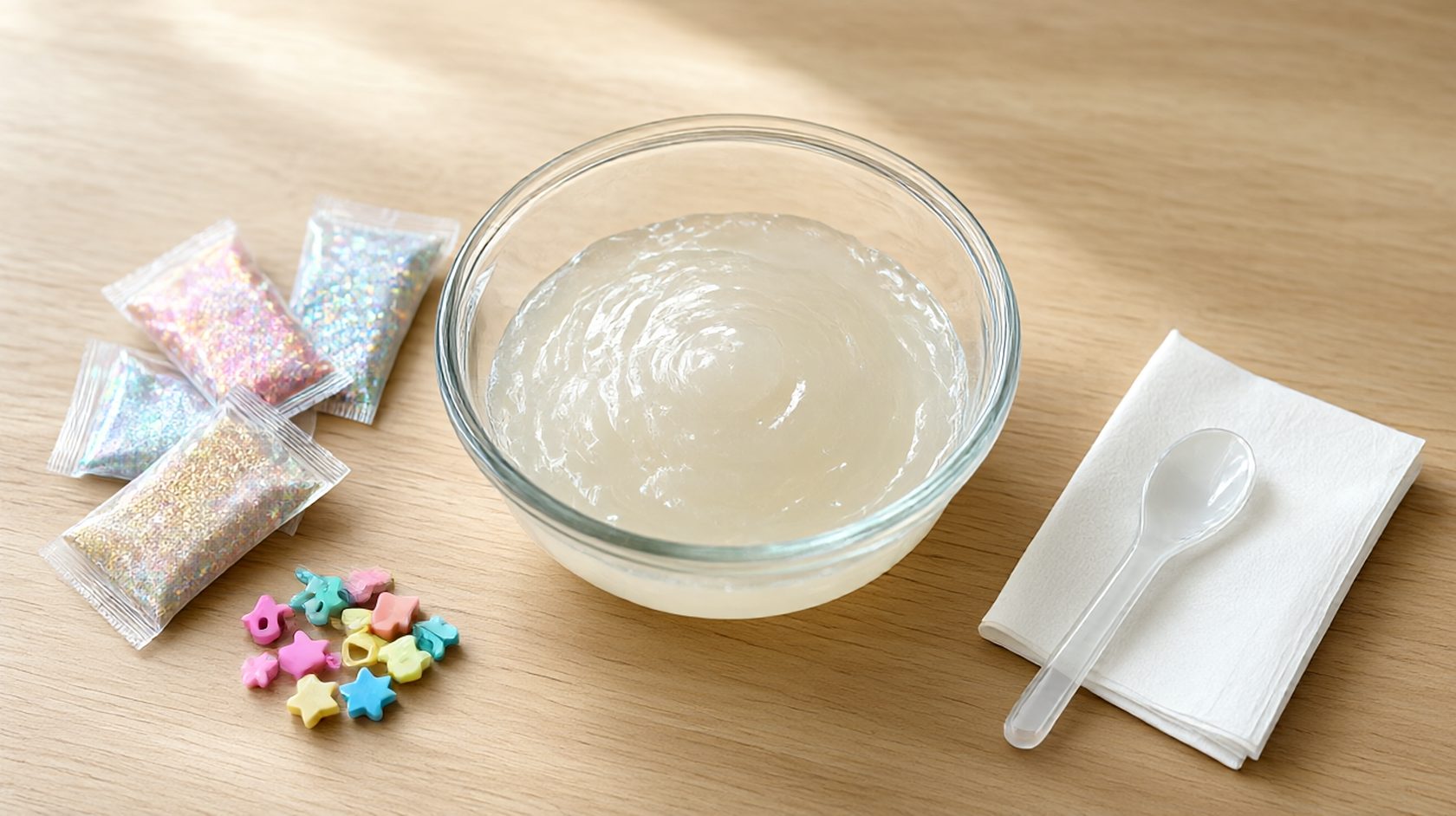
What is actually in the pot
A typical slime is a polyvinyl alcohol solution cross-linked with borate, thickened with guar or xanthan, and preserved. The proportions decide whether it is stretchy, bouncy, glossy or crumbly.
Polyvinyl alcohol is the backbone. Its concentration sets the slime's body; too little and the slime is a liquid that flows off the hand, too much and it is a rubber that tears instead of stretching.
The borate source is usually a borax solution or a boric acid-based activator. The ratio of borate to polymer is the single most sensitive number in the formula, and it is the number a factory changes when it wants a cheaper product.
Preservatives matter more than most buyers realise. A slime with inadequate preservation develops mould in a warm warehouse within weeks, and the mould is discovered by a customer rather than by the factory.
Water loss and the pot that shrinks
Slime is mostly water. A pot that is not sealed loses water through the lid, and the slime loses volume, hardens and becomes brittle at the edges.
The rate of loss depends on the lid's seal, the pot's wall thickness and the headspace. A thin-walled polypropylene pot with a push-fit lid loses water faster than a thicker pot with a lined lid.
The commercial consequence is a product that looks smaller on the shelf than it did at packing, and a customer complaint about short weight rather than about quality.
The fix is a pot with a defined seal, a specification of the fill weight with a tolerance, and a storage test at 40 degrees Celsius for four weeks. The storage test predicts the shelf behaviour better than any calculation.
Leak paths that are not the lid
Most leaks are blamed on the lid, and most leaks are at the lid's interface with the pot's rim - a moulding flash, a warped rim, or a lid that is the wrong diameter for the pot.
The second leak path is the label. A wrap label that crosses the lid seam can lift the seal as it shrinks, which is an argument for keeping labels off the sealing surface.
The third is the carton. A pot that is packed loose in a carton will have its lid worked loose in transit; a pot that is packed with a fitment or a sleeve arrives with its seal intact.
A transit test with a full carton - drop, vibration and a week at 40 degrees - finds all three. It is the cheapest test in the programme and the one most often skipped for a first order.
Kits, components and the compatibility problem
A kit with 126 pieces is a kit with 126 chances for a component to be wrong. The components that matter are the ones that touch the slime: the activator, the glitter, the charms and the storage pot.
Glitter is a compatibility issue rather than a decoration. A metallic glitter with a solvent-based coating can leach into the slime and change its colour; a polyester glitter with an inert coating does not.
Charms and beads have to be sized for the age grading. A kit for six-plus can carry small parts; a kit for three-plus cannot, whatever the marketing says.
The component list should be checked against the age grading and the material declarations before the packaging is printed, because the packaging is the expensive thing to change.
Mould, bacteria and the preservative argument
Slime is a water-based product with sugar-containing additives, and it is a favourable environment for microbiology. Preservation is not optional.
The usual preservative system is a blend of cosmetic-grade actives, and its effectiveness depends on pH. A slime that drifts to pH 6 from pH 8 can lose its preservation without any visible change.
Testing is a challenge test: inoculate the product, hold it, and count. A product that passes a challenge test at the formula stage can still fail in a pot that was filled warm, so the fill temperature belongs in the process specification.
A factory that tests only the raw materials is a factory that will discover its preservation problem in the market. Ask for the finished-product challenge test, not the supplier's certificate.
The label that carries the liability
A slime kit's label carries more than a brand: age grading, warnings, the responsible person in the destination market, and the batch code that ties the pot to a production record.
The batch code is the part that most factories treat casually and most buyers need first. Without it, a complaint cannot be traced to a resin lot, a preservative lot or a filling run.
The warning text is market-specific and it is not a translation exercise. A warning that is compliant in one market can be incomplete in another, and the retail audit checks the label rather than the product.
The label artwork should be approved against the destination market's checklist and held in the technical file, so that a later reprint does not quietly drop a required line.
Filling, capping and the line that leaks
Slime is filled by weight, and the fill head's accuracy decides the pot's headspace. A pot filled to the brim leaks when the lid compresses the contents; a pot with too much headspace loses water faster.
The capping machine's torque is the second variable. Too little torque and the lid works loose in transit; too much and the lid's thread strips or the pot's rim deforms.
The third is the fill temperature. A slime filled warm carries more water vapour into the headspace, and that vapour condenses on the lid and looks like a leak.
A filling line that measures torque and fill weight on every shift is a line that ships cartons without leaks. A line that measures neither is a line that learns from complaints.
The refill economy and the second purchase
Slime kits are often bought once and refilled afterwards, and the refill is a different product with different economics: a larger pot, a simpler label, a lower price.
A refill that uses the same pot and lid as the kit is a refill that inherits the kit's leak performance. A refill with a bigger pot usually needs a different lid, and the lid is where the cost sits.
The refill's formulation can be simpler - fewer charms, a single colour - and it should be, because the buyer has already been convinced by the first purchase.
Brands that treat the refill as an afterthought lose the second purchase to a competitor's kit. The refill is the retention product, not the discount product.
The activator and the parent's first experience
The activator is the part of a slime kit that a parent handles, and it is usually a small bottle of borax solution with no clear instruction about quantity.
A kit that says 'add a little' produces either a slime that will not set or one that is hard and crumbly. A measured dropper removes the guesswork and the review that follows it.
Storage and the pot that becomes a habitat
A slime stored in a warm room for a month will change, whatever the preservative. The pot should be small enough that the product is used within its shelf life.
A large pot at a low price encourages storage, and storage is where slime fails. The unit size is a quality decision.
The shelf life stated on the pot
A slime's shelf life is set by its preservation and its packaging, and it should be printed on the pot rather than on the carton. A pot separated from its carton is a pot whose age nobody knows.
A twelve-month claim assumes a sealed pot and a normal warehouse. A pot that has been opened and resealed is a different product, and the label should say so.
For a kit whose pot has to survive a warm warehouse, the DIY slime kit is the example to open: its lid, fill weight and component list show how the formulation and the packaging were decided together.
What to check
- Borate-to-polymer ratio fixed in the formula record
- Finished-product challenge test, not just raw material certificates
- Fill weight and storage test at 40 C for four weeks
- Transit test on a full carton with drop and vibration
- Batch code linking pot to production record
- Age grading checked against every component in the kit