Bench note · 19 November 2026
Stress balls: filling, burst strength and the file the buyer needs
A stress ball is a filled elastomer shell, and most of its failure modes come from the fill: too much, too little, or the wrong thing entirely.
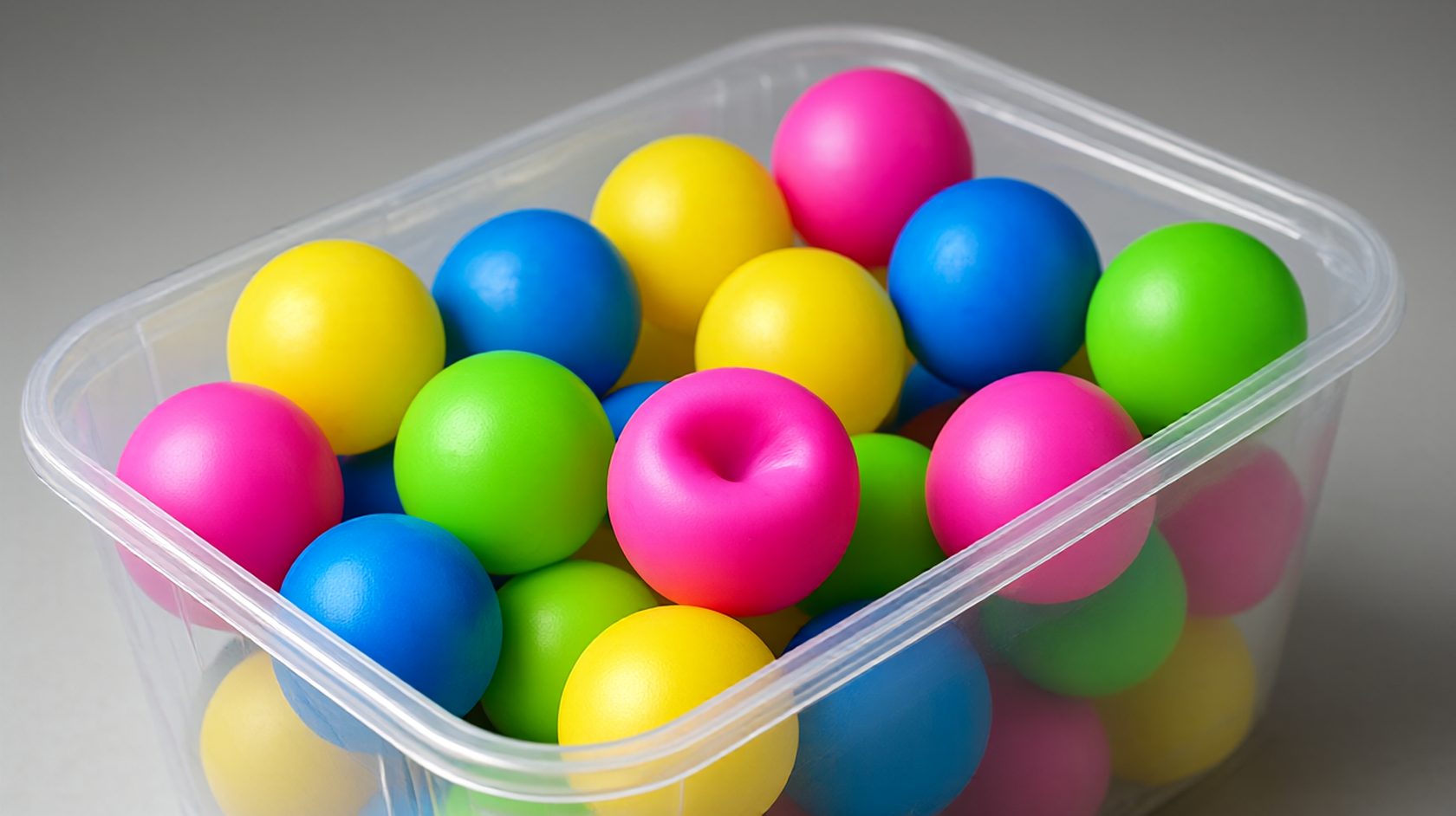
The shell and the fill
A stress ball is a hollow elastomer - natural rubber, TPR or silicone - filled with a powder, a gel or air. The shell provides the feel; the fill provides the resistance.
Powder fills are the cheapest and the most forgiving: a fine talc or a starch-based filler gives a slow, doughy compression. Gel fills feel more expensive and fail more spectacularly when the shell splits.
Air-filled balls are the lightest and the least satisfying, and they are the ones most likely to be returned as 'not squishy enough'.
The fill weight is a design decision, not a packing decision. A ball filled to ninety per cent feels firm; the same shell at seventy per cent feels soft and returns slowly.
Burst strength and the seam
The shell's weakest point is the seam or the neck where it was filled. A ball that bursts does so at the fill point, and it bursts when it is squeezed hard or dropped on a corner.
Burst strength is tested by inflating a sample to failure, or by compressing it between platens until it splits. The number that matters is the pressure at failure divided by the wall thickness.
A ball that passes a static compression test can still fail in a child's hands, because the failure mode is cyclic rather than monotonic: squeeze and release two thousand times, and the seam work-hardens.
The test programme should include a cyclic test - a simple pneumatic rig will do - and the result should be in the technical file rather than in a laboratory's memory.
Fill material and the regulatory question
Powder fills are the regulatory-sensitive part. A talc fill invites a conversation about respirable dust if the ball bursts; a starch fill invites a conversation about mould.
Gel fills are usually mineral oil or a glycerine blend, and both are covered by the toy safety directive's chemical requirements. The safety data sheet is not enough; the fill's composition has to be declared.
A ball that is marketed for adults as a desk toy is still a toy if it is shaped, coloured and packaged to appeal to children. The classification follows the product's presentation, not the label's intent.
The file should name the fill, its safety data sheet, its migration test if the fill can leach, and the reasoning behind the age grading.
Printing, coating and the surface that peels
A logo printed on an elastomer shell is a logo that will peel. The ink has to be flexible, the surface has to be prepared, and the print has to be cured at a temperature the elastomer tolerates.
Pad printing with a two-component ink is the usual method. A one-component ink that relies on solvent evaporation will crack at the first squeeze.
The test is a print adhesion test after a hundred compressions. A print that survives a hundred squeezes will survive a retail season.
Where the logo is moulded rather than printed, the tool's engraving depth decides legibility. A shallow engraving disappears when the ball is squeezed, which is exactly when the logo is most visible in use.
Odour, plasticiser and the sealed carton
Elastomer shells carry odour from their curatives and from the plasticiser. The odour is strongest in the first weeks and in a sealed carton.
The control is a defined post-cure and a defined resting period before packing. A ball packed the day it was moulded is a ball that arrives with the factory's smell.
The buyer's test is a carton opened after a week at 40 degrees. A strong odour at that point is a product that will be described as chemically smelling in reviews.
Odour is also a proxy for volatiles, and volatiles are what a retail audit's lab will measure. A product with a clean odour profile usually has a clean volatile profile.
The retail unit that survives handling
Stress balls are sold in bins, on hanging cards, and in counter units. Each format has a different handling load, and the product's packaging has to match.
A hanging card needs a hole that does not tear, and a ball that is wired to the card needs a wire that does not cut the shell. Both failures are common and both are visible in a store.
A bin display needs a ball that can be picked up and squeezed by a hundred people before purchase, which means a printable surface that resists handling and a shell that does not pick up lint.
The packaging decision should be made with a handling test: drop the unit, hang it for a week, squeeze it fifty times. Three tests that predict whether the product looks new on the shelf.
Printing on a surface that moves
Pad printing on an elastomer is a compromise between ink adhesion and substrate movement. The pad compresses the shell, and the print lands on a surface that is still rebounding.
A two-component ink cured at a temperature the elastomer tolerates is the reliable route. A UV ink on a soft shell cures hard and cracks at the first squeeze.
The print's position matters as much as its adhesion: a logo on the area that takes the most compression will fail first, whatever the ink.
The test is a hundred compressions plus a rub with a thumb. A print that survives both survives a retail bin.
The counter display and the pilferage question
A counter unit of stress balls is a unit that loses stock to handling, and the packaging has to survive repeated picking up and putting down.
A ball without individual packaging is cheaper and dirtier; a ball in a poly bag is cleaner and looks less inviting. The compromise is usually a printed card with the ball wired to it.
The card's hole and wire are the failure points. A card that tears at the hole leaves the product on the counter as loose stock.
The display decision should be tested with the actual unit in a busy environment for a week. A unit that survives a week of handling survives a season.
The seam that fails first
A moulded ball has a seam line, and the seam is where the shell is thinnest. A ball that bursts at the seam was designed with a seam in the wrong place.
The seam should run away from the highest-stress area, and the tool should be vented at the seam so that the knit line is clean rather than porous.
Fill that settles
A powder fill settles in transit, and a settled ball feels empty at the top. A gel fill does not settle, which is one of the reasons it commands a higher price.
The fill should be specified as a weight per unit, and the settling should be measured after a vibration test rather than assumed.
The ball that is too heavy to post
A filled ball is heavy, and the shipping cost changes the retail price more than the fill does. A lighter shell and a lighter fill can halve the cost of a unit.
The trade is feel against freight. A ball that feels right in the hand can be unaffordable to ship, and the compromise is usually a smaller diameter.
Sampling a batch for burst
Burst testing is destructive, so it is done on a sample. The sample size should be set by the batch size and by the defect rate the buyer will accept.
A batch of ten thousand with a one per cent burst rate is a hundred failed balls in customers' hands. The sample has to be large enough to see one per cent.
The claim about stress relief
A stress ball's marketing often claims therapeutic benefit. That claim is a medical claim in some markets, and it needs evidence rather than adjectives.
The safer claim is about the product's function - squeeze, recover, fidget - and it is also more honest.
The unit that ends up in a drawer
A ball that is too firm or too soft ends up in a drawer, and the review says so. The feel is the product, and the feel is the hardest thing to specify.
The specification should include a compression force at a defined deflection, measured on a press. A number that can be checked is a number that can be repeated.
For a shell that has to survive a thousand squeezes, the grape stress ball is the unit whose fill weight and seam are worth inspecting first.
What to check
- Fill weight and feel specified on a physical sample
- Cyclic compression test on the fill seam, not just static burst
- Fill composition and safety data sheet in the technical file
- Print adhesion after 100 compressions
- Post-cure and resting period before packing
- Handling test on the actual retail format