Bench note · 19 November 2026
TPR squishy toys: what the material decides before the mould does
Thermoplastic rubber is the reason a squishy toy feels the way it does. It is also the reason a batch fails, a shipment smells, and a retail buyer sends a sample back.
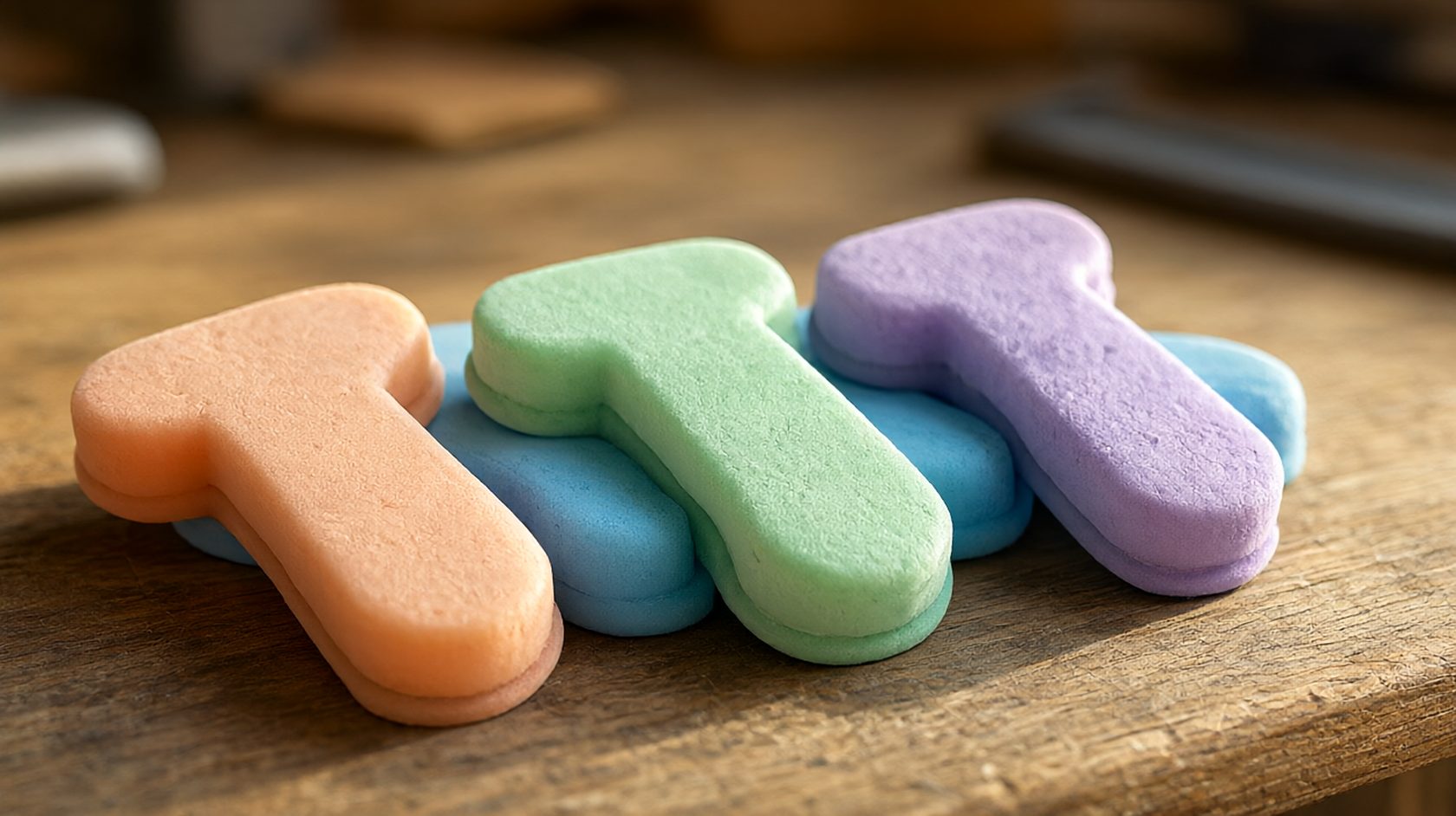
Why TPR, and what it is
Thermoplastic rubber is a block copolymer - usually styrene-butadiene-styrene - compounded with mineral oil, filler and a little antioxidant. It is not rubber in the vulcanised sense; it softens with heat and can be injection moulded or extruded like any thermoplastic.
That is the whole commercial argument. A factory can run TPR on the same machines it uses for polypropylene, with the same tooling approach, and get a part that feels soft, grippy and heavy in the hand.
The feel is a function of the oil. More oil means a softer compound and a lower hardness on the Shore A scale; less oil means a firmer part that holds its shape better in a warm room.
A squishy toy is therefore a formulation decision before it is a design decision. Two factories can make the same shape from the same drawing and deliver products that feel nothing alike.
Shore hardness is not the specification
Buyers ask for a hardness number, and factories quote Shore A 25 or 35 as though it settles the question. It does not, because hardness is measured on a flat slab under a defined load and a moulded toy is neither.
What a buyer actually wants is a compression feel: how much force it takes to deform the part by a centimetre, and how quickly it returns. That is a design target, and it maps to hardness plus wall thickness plus the internal geometry.
A hollow part at Shore A 40 can feel softer than a solid part at Shore A 25. The wall thickness does more work than the compound, which is why the drawing and the formulation have to be agreed together.
The practical solution is a physical sample in the buyer's hand, signed off against a written description of the feel. A hardness number alone will always produce an argument at inspection.
Oil, migration and the surfaces that go sticky
The mineral oil that makes TPR soft does not stay put forever. Under warm storage it migrates toward the surface, and the part develops a tacky film that collects dust and sticks to packaging.
Migration is normal and it is manageable. A compound with a higher molecular weight oil, or with the oil pre-dispersed in a masterbatch, migrates more slowly than a compound where the oil was added at the press.
The visible symptom is a print or a label that will not adhere, or a toy that arrives stuck to its blister. Both are failures of formulation rather than of packing, and both are caught late.
The test is a week in a warm chamber at 45 to 50 degrees Celsius, with the part in its actual packaging. A week in the chamber is worth a month in a warehouse, and it costs almost nothing to run.
Odour, and the batch the buyer rejects
TPR smells of its oil. Some of that is unavoidable, and some of it is the sign of a compound that used a cheap paraffinic oil or an under-degassed regrind.
The odour that matters is the one that survives a week in a sealed bag. A part that smells faintly on the line and strongly in the bag is a part that will be returned by a retail buyer who opens a carton.
The control is twofold: specify the oil type and a maximum odour rating in the purchase order, and test the first article in a sealed bag at room temperature for 72 hours.
A factory that cannot state its oil type is a factory that is buying on price. The question is a useful one to ask early, because the answer tells you what the next year of quality will look like.
Regrind, colour and the second batch
Most TPR parts run with some regrind, and the proportion is the thing to fix in writing. Ten per cent regrind is normal; forty per cent is a cost reduction that shows up as colour drift and inconsistent feel.
Regrind also carries the oil history. A part that has been reground twice has been heated three times, and the oil has migrated and partly degraded in each cycle.
Colour is the visible evidence. Masterbatch added at the press gives a consistent colour; colour concentrate mixed into regrind gives a batch that varies from part to part and from box to box.
The specification should name the regrind percentage, the colour method and the acceptable colour difference against a signed standard. Three lines in a purchase order that prevent a season of complaints.
The sample that survives a retail audit
A retail audit asks for the technical file, not the sample. The file needs the compound's material declaration, the heavy metal and phthalate test reports, the age grading and the warning text.
The material declaration is where TPR gets interesting: the compound is a mixture, and the supplier's declaration has to cover the oil, the filler and any process aids, not just the polymer.
A factory that can produce a full declaration for its compound is a factory that buys from a compounder rather than mixing oil into pellets in-house. The declaration is a proxy for process control.
Keep the approved sample with its batch code and its test reports in one file. When a later batch is questioned, that file is the only thing that settles the argument quickly.
Mould design for a soft compound
A soft TPR part is a part that shrinks more than the tool was drawn for. Shrinkage for a 25 Shore A compound can be three to five per cent, and it is not uniform across a thick and a thin section.
The tool has to be cut for the measured shrinkage of the production compound, not for the sample's compound. A sample made by a lab press and a tool cut for the lab's shrink rate will produce parts that are consistently small.
Gate position matters more than in a rigid part. A soft compound fills slowly and a gate at one end of a long part leaves a flow mark that reads as a colour difference.
Venting is the third item. A soft compound traps air in a deep cavity, and the trapped air becomes a void that shows up as a soft spot in the finished toy.
Second source, and the tool you do not own
Buyers often plan a second source and discover that the second factory cannot make the same part. The tool exists, the compound does not, and the compound is the part's identity.
A compound specification - hardness, oil type, melt flow, colour method - is what transfers between factories. A sample alone does not, because the sample's compound is undocumented.
The tooling clause and the compound clause belong together in the contract. Owning the tool without owning the compound leaves the buyer with a mould that only one factory can fill.
The practical answer is to buy the compound from a named compounder rather than from the factory's own mixer. Then the second source can buy the same compound, and the product stays the product.
The colour standard that survives the season
A colour approved on a lab chip and a colour produced on the line can differ by a visible step, especially in pale tints and deep saturated shades.
The standard should be a production part, not a lab chip, and it should be held in a drawer away from daylight. A standard that has faded is worse than no standard.
Packing and the part that arrives deformed
A soft part packed under load will arrive deformed, and it will not always recover. A ball squashed against a carton wall for a month keeps a flat where it touched.
The packaging should give the part a cavity rather than a squeeze, and the carton should not be filled to the point where the parts carry the stack.
The batch record that answers a complaint
A TPR part's complaint is usually about feel or smell, and the answer is a comparison against the batch that was approved. Without a batch record naming the compound lot and the oil, the comparison cannot be made and the complaint becomes a negotiation.
The record should be short: compound lot, oil type, colour lot, press and date. Four fields that turn a complaint into a traceable question.
A compound that holds its feel across a batch is the one behind the TPR squishy toy, and its oil type is the question worth asking before the tool is cut.
What to check
- Feel signed off on a physical sample, not a hardness number
- Oil migration tested in the actual packaging at 45-50 C for a week
- Regrind percentage and colour method fixed in the purchase order
- Compound material declaration covering oil and filler
- Odour checked in a sealed bag for 72 hours